

Best Screen Free Gifts for Kids: A Parent's Buying Guide
Table of Contents
- Why Screen Free Gifts Are Worth the Effort
- How to Choose Screen-Free Toys for Kids
- Outdoor Gifts for Kids That Get Them Outside
- Screen-Free Activities for Kids: What Works at Home
- Screen-Free Gifts for 5 to 10 Year Olds
- Budget Tiers and What You Actually Get
- Common Gift-Buying Mistakes to Avoid
- Frequently Asked Questions
Last Updated: October 21, 2026
Why Screen Free Gifts Are Worth the Effort
At Talkio, we spend our days curating toys that pull kids outdoors and into real-world play, so we have a clear bias here.
The Australian Government's physical activity and screen time guidelines for children set out how much movement and seated screen time children should aim for each day.
Below, we break down how to choose screen-free toys, which categories deliver the most play value, and where parents waste money.
How to Choose Screen-Free Toys for Kids
Choosing a screen-free toy comes down to two questions: does it match how this child actually plays, and will it survive a month of real use? Get both right and the gift gets played with. Get either wrong and it joins the pile.
Match the Toy to the Child's Play Style
Watch a child for ten minutes and their play style shows up fast. Builders want to construct. Storytellers want costumes and props.
Buy against that grain and you waste money. A quiet child handed a loud group game will retreat.
A common mistake is buying for the parent's taste rather than the child's. If you are unsure, ask what they do at school lunchtime.
Check Durability, Safety and Materials
Outdoor toys take punishment. Look for solid joints, thick plastics, and stitching that will not split. Avoid anything with tiny detachable parts if younger siblings are around.
In Australia, toys supplied to children up to 36 months must meet the mandatory safety standard, and all toys should carry age guidance. The ACCC product safety guidance on toys explains what to check before you buy.
Outdoor Gifts for Kids That Get Them Outside
Outdoor gifts work best when they give kids a job to do or a reason to communicate.
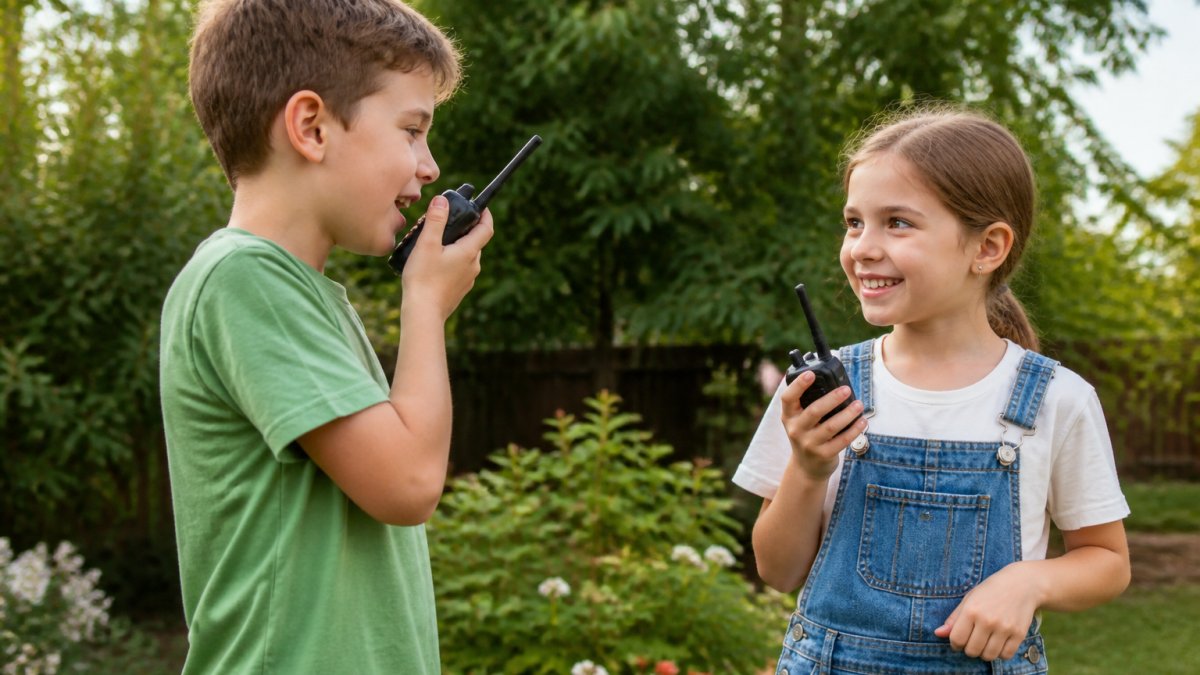
Our Talkio™ Kids Walkie Talkies ($34.99) are the clearest example.

That last point matters more than the range. A child with a walkie talkie is negotiating, planning and coordinating with a sibling or friend.
Other strong outdoor picks: magnifying bug viewers, garden tool sets sized for small hands, and rope-free obstacle kits.
Screen-Free Activities for Kids: What Works at Home
The screen-free activities that stick are the ones with the lowest setup cost. If a parent has to assemble, supervise and clean up, it happens once. The second filter is fit: an activity that suits a child's play style and the room it happens in gets reached for again and again.
Rank activities by how quickly a child can start, then by how well they suit your space and noise tolerance:
- Reusable sticker scenes, pull out, play, peel off, repeat. Low mess, quiet, and small enough for a cafe table.
- Magnetic play sets, instant, quiet, and travel-friendly. Pieces stay put on a tray or tin, which makes them a strong small-space pick.
- Marble runs, building plus physics, with real replay value. Best on a floor with a contained edge so marbles do not escape under furniture.
- Craft kits, best when everything needed is in the box. Check for washable materials and a clear drying space before you buy.
- Audio stories and music players, screen-free listening for car rides and quiet time. Headphones or a shared speaker change the experience entirely.
Small-Space, Low-Mess and Quiet-Play Picks
Not every home has a playroom, and not every parent wants glitter on the kitchen bench. These options work in apartments, restaurants, waiting rooms and quiet time:
- Magnetic drawing boards, one piece, no loose parts, instantly reusable
- Reusable sticker books, peel-and-stick scenes that pack away flat
- Travel puzzle tins, a small number of pieces, a lid that doubles as a tray
- Audio players with story cards, screen-free listening that needs no adult setup
Matching Activities to Play Style and Ability
The same activity can be a hit or a miss depending on the child. A quick chooser:
- Builders, marble runs, construction kits, magnetic tiles
- Makers, craft kits, reusable sticker scenes, art supplies
- Storytellers, felt story sets, pretend play props, audio stories
- Movers, outdoor obstacle kits, garden tools, walkie talkies
- Quiet players, puzzles, magnetic drawing boards, audio players
Ability note: for children with sensory sensitivities, favour activities with low noise and predictable textures. For children with fine-motor differences, choose larger pieces and avoid kits that require precise assembly. A common pattern is that the activity a child chooses themselves gets far more use than the one an adult selects for them.
Screen-Free Gifts for 5 to 10 Year Olds
Ages 5 to 10 is the sweet spot for screen-free gifts, and also the hardest range to buy for. Five-year-olds and ten-year-olds want completely different things, and a gift that lands with one will often sit untouched with the other.
Use this age-by-age guide as a starting point, then adjust for the individual child. A confident 6-year-old may handle an 8+ building set; a cautious 9-year-old may still prefer open-ended pretend play.
Ages 3 to 4: Cause, Effect and Chunky Hands
At this stage, children are learning that their actions make things happen. Look for:
- Chunky building sets with pieces large enough to grip and too big to swallow
- Simple inset puzzles with knobs and matching pictures
- Pretend play props, play food, doctor kits, tool sets, that invite copying adults
- Reusable sticker scenes with thick, peelable pieces
Supervision note: anything with small detachable parts is a choking risk if younger siblings are nearby. Check the mandatory safety standard for toys supplied to children up to 36 months, and treat 3-4 as a stage where mouthing can still happen.
Ages 5 to 7: Curiosity Without Reading
Five- to seven-year-olds want to build, sort, and pretend, but they are not yet fluent readers. Choose toys that reward curiosity without demanding instructions:
- Magnetic play sets, instant, quiet, and travel-friendly
- Marble runs, building plus early physics, with real replay value
- Simple board games with picture-based rules and short rounds
- Art supplies, chunky crayons, washable markers, and paper that tolerates heavy use
Ability note: this is the age where fine-motor differences show up clearly. If a child struggles with small pieces, choose larger components and avoid kits that require precise assembly.
Ages 8 to 10: Challenge and Complexity
Eight- to ten-year-olds want challenge and mastery. Shift toward:
- Strategy games with real decision-making and multiple paths to winning
- Logic puzzles and brain-teaser books that scale in difficulty
- Construction kits with genuine complexity and moving parts
- Walkie talkies, this is the age where kids start exploring further from the back door, and communication becomes genuinely useful
Supervision note: this is also the age where outdoor range and independence expand. Set boundaries before a walkie talkie set goes out the door, and check battery life so the toy does not fail mid-adventure.
Ages 11 to 12: Autonomy and Real Tools
Older kids often reject toys that feel babyish. Favour gifts that look and function like real equipment:
- Quality art materials, proper sketchbooks, decent pencils, a real set of brushes
- Complex building systems with engineering or coding-free mechanical elements
- Outdoor gear, bug viewers, compasses, garden tools sized for older hands
- Audio stories and music players for screen-free listening during quiet time
One Gift for Mixed Ages
If one product has to cover both a 4-year-old and an 11-year-old, pick something with open-ended rules. Walkie talkies, building sets and art supplies scale up naturally. A single-purpose electronic toy does not. When in doubt, choose the toy the older child will not feel embarrassed to use and the younger child can safely handle with supervision.
Budget Tiers and What You Actually Get
Price does not track play value in a straight line. Here is how the tiers actually break down.
| Budget tier | Typical spend (AUD) | What you get | Watch out for |
|---|---|---|---|
| Under $30 | $15-$30 | Craft kits, puzzles, reusable stickers, small outdoor toys | Thin materials, missing pieces, short play life |
| $30-$60 | $30-$60 | Walkie talkies, magnetic sets, mid-size building kits | Packaging that hides flimsy parts |
| $60-$120 | $60-$120 | Large construction sets, quality board games, art supplies | Complexity that outpaces the child's age |
| $120+ | $120+ | Big-ticket building systems, outdoor play equipment | High cost, low replay value if it does not match play style |
Total cost of ownership matters as much as sticker price. A $34.99 walkie talkie set that gets used every weekend for two years beats a $20 novelty that breaks in a month. Batteries, replacement parts and storage all add up, so factor them in.
Common Gift-Buying Mistakes to Avoid
The biggest mistake is buying the toy the adult finds impressive. Children are rarely impressed by the same things.
Other traps we see often:
- Ignoring the age range. A toy marked 8+ handed to a 5-year-old becomes a frustration, not a gift.
- Buying one big thing instead of one flexible thing. Open-ended toys get played with far longer.
- Skipping the batteries. A gift that cannot be used on the day loses its moment.
- Assuming outdoor means adventurous. Backyard play counts. Suburban families get just as much from a walkie talkie set as camping families do.
- Overloading. One well-chosen screen-free toy beats five forgettable ones.
The hard part is not finding screen-free toys.
That is exactly what we focus on at Talkio.
Start with one toy that matches how your child plays. Get started with Talkio and give them a reason to leave the screen on the bench.
Frequently Asked Questions
What are some good gifts to help kids get off screens?
Look for gifts that need active participation rather than passive watching. Building sets, puzzles, craft kits and outdoor gear all work because the child has to do something to make them fun. Walkie talkies are a strong option too, since kids use them to coordinate real games like hide and seek. The best screen free gifts match the child's interests: a child who loves drawing will use art supplies for hours, while a physical kid will get more from a ball, scooter or outdoor adventure kit.
What are the best screen-free gifts for kids by age?
For toddlers and preschoolers, choose chunky puzzles, sensory play items and simple pretend play sets. For 5 to 7 year olds, craft kits, magnetic tiles and basic board games hit the sweet spot. Kids aged 8 to 10 usually want more challenge: strategy games, complex building sets and outdoor gear like walkie talkies or a bike. Age labels on packaging are a starting point, but the child's actual interests matter more than the number on the box.
How do I choose a screen-free gift a child will actually use?
Watch what the child already does in their free time. If they build with cushions and boxes, a construction set will land well. If they talk constantly and invent games, walkie talkies or a puppet set suit them. Ask their parents what they're into right now, and avoid buying for the child you wish they were. Also check durability: cheap plastic breaks fast and ends up in a drawer. A well-made gift that survives rough play gets used far more often.
Which gifts encourage kids to play outside?
Anything that works better outdoors than indoors. Walkie talkies, balls, skipping ropes, bug catchers, garden tools and water play sets all push kids toward the backyard. The Talkio Kids Walkie Talkies ($34.99) are a good example: they have a range of up to 3 km in open areas, run on included AA batteries and need no phone or Wi-Fi, so kids can roam and stay in contact. Pair an outdoor gift with a simple challenge, like a scavenger hunt, to get them started.