

Buy High Quality Wooden Outdoor Toys: 2026 Buying Guide
Table of Contents
- Why Wooden Outdoor Toys Beat Screens and Plastic
- Wooden Outdoor Toys for Kids: What to Look For
- Wooden Outdoor Play Equipment by Age and Backyard Size
- Safe Outdoor Toys for Kids: Standards and Inspection Checks
- How to Care for Wooden Outdoor Toys Season After Season
- Sustainability Claims and Material Verification
- Assembly, Delivery and After-Sales Support
- Conclusion
- Frequently Asked Questions
Last Updated: October 20, 2026
Why Wooden Outdoor Toys Beat Screens and Plastic
A backyard full of timber play equipment does something a tablet cannot: it pulls children outside without being asked.
The case for buying high quality wooden outdoor toys rests on three practical points.
- Wood ages instead of failing. A decent hardwood frame can be sanded and refinished. Cracked plastic usually goes to landfill.
- Timber invites touch. Grain, weight and warmth make wooden outdoor toys for kids feel like real objects, which is why they hold attention across age groups.
- Repair beats replacement. A loose bolt or a weathered board is a ten-minute fix. There is no equivalent for a split plastic slide.
Plastic has its place, mostly where weight matters. For anything that stays in the yard, timber wins on longevity and on how often it actually gets used. That is the argument this guide builds on.
Wooden Outdoor Toys for Kids: What to Look For
Start with the frame, not the colour. Most problems with wooden outdoor play equipment trace back to undersized timber, hidden fixings or a finish that cannot handle sun and rain.
Work through these checks before you buy:
- Timber thickness. Load-bearing posts should feel solid in the hand. Thin posts flex under swinging weight.
- Joint construction. Bolted or through-fixed joints outlast staples and screws driven into end grain.
- Hardware. Stainless steel fixings resist rust far better than zinc-plated ones near the coast.
- Finish. Look for a penetrating oil or water-based stain rather than a thick film that traps moisture.
- Edges and corners. Rounded, sanded edges matter most on items aimed at younger children.
Timber Species, Finishes and Weather Resistance
Species choice decides how a piece behaves over five or ten years. Treated pine is affordable and widely used, but it needs regular sealing. Hardwoods such as spotted gum or merbau cost more and hold up longer in full sun.
Finish matters as much as species. Penetrating oils soak into the grain and let the timber breathe. Film-forming paints look sharp for a season, then blister and trap water underneath.
Wooden Outdoor Play Equipment by Age and Backyard Size
Match the equipment to the child first, then to the space. A four-year-old and an eleven-year-old need very different things from the same backyard, and buying for the older child usually means the younger one cannot use it safely.
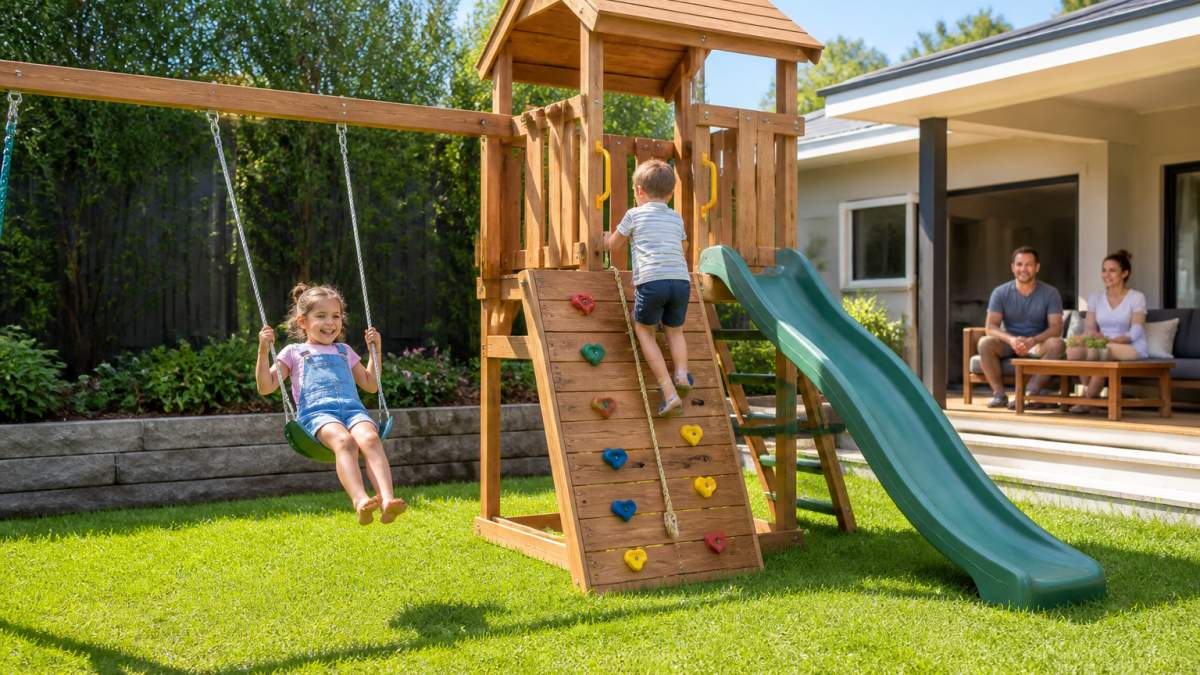
Most retail category pages stop at a product grid.
A practical comparison of common timber toys
| Toy type | Typical age band | Approximate footprint | Fall zone to allow | Key buying checks |
|---|---|---|---|---|
| Sandpit with lid | 1-5 years | 1.2 m × 1.2 m to 1.8 m × 1.8 m | 1 m clear around edges | Lid hinge quality, drainage, timber thickness of sides |
| Mud kitchen | 2-6 years | 0.8 m × 0.5 m | 1 m clear in front | Stability of legs, stainless or coated fixings, removable bowl |
| Low slide (timber frame) | 2-5 years | 1.5 m × 0.6 m | 1.5 m at run-out | Side rails, non-slip steps, smooth sanded edges |
| Swing set (single bay) | 3-10 years | 2.5 m × 2 m | 2 m front and back | Post diameter, anchor type, seat adjustability |
| Climbing frame / monkey bars | 5-12 years | 2.5 m × 2 m | 2 m all sides | Rung spacing, grip diameter, through-bolted joints |
| Cubby house | 3-10 years | 1.5 m × 1.5 m to 2.4 m × 2.4 m | 1 m clear around walls | Floor height, roof ventilation, window safety |
| Wagon or wheelbarrow | 2-8 years | 0.8 m × 0.4 m | Not applicable | Wheel bearing quality, tipping mechanism, handle height |
Use the footprint and fall-zone columns together. A swing set that fits the lawn but leaves no safe run-out is not a fit. Measure the actual yard, not the product photo, and allow for the arc of a swing at full extension.
Age bands and what changes
- 3-5 years: ground-level play dominates. Sandpits, mud kitchens and low slides build confidence without height. Look for rounded edges and low fall heights.
- 5-8 years: gross motor skills take off. Climbing frames, swing sets and cubby houses give challenge and imaginative space. Check load ratings and anchor systems.
- 8-12 years: children want difficulty. Monkey bars, taller climbing structures and wagons with real load capacity suit this band. Confirm the frame is rated for the child's weight, not just their age.
A common pattern is buying one large structure for a wide age gap. The older child outgrows it, the younger one is not ready, and the frame sits unused. Two smaller pieces usually get more total play time than one big one.
Small backyards, budgets and shared play
Courtyard-sized yards still work. A sandpit with a lid, a compact mud kitchen and a single swing arm cover active and imaginative play without eating the whole lawn.
For shared play across ages, pick items with adjustable elements.
Budget for the total cost, not the sticker price. Delivery, assembly, anchoring kits, ground preparation and replacement parts all add to the figure.
Safe Outdoor Toys for Kids: Standards and Inspection Checks
Safety comes down to two things: buying equipment that meets recognised standards, and checking it regularly once it is built.
Ask the retailer which standard the product is tested to. In Australia, children's playground equipment is covered by the AS 4685 series, and domestic trampolines by AS 4989.
Run this inspection monthly, and after any big storm:
- Check all bolts and fixings for tightness
- Look for splinters, cracks or lifting finish on timber
- Test swing chains and rope for fraying
- Clear the fall zone of rocks, roots and toys
- Confirm no sharp edges have appeared through wear
- Check that anchors are still firm in the ground
The Product Safety Australia guidance on outdoor play equipment is worth reading before you buy, particularly on anchor requirements and fall zones.
How to Care for Wooden Outdoor Toys Season After Season
Care is simpler than most parents expect, but it has to happen on a schedule. Learning how to care for wooden outdoor toys mostly means learning to look at them twice a year, and knowing what a realistic maintenance budget looks like before you buy.
A realistic care calendar
| When | Task | Time | What to use |
|---|---|---|---|
| Monthly | Visual check of fixings, edges and anchors | 5-10 minutes | Eyes and a spanner |
| After storms | Check for loose bolts, split timber, pooled water | 5 minutes | Spanner, cloth |
| Spring | Wash down, sand rough patches, re-oil dry timber | 2-4 hours | Mild soap, medium and fine grit, penetrating oil |
| Autumn | Tighten fixings, clear drainage, store loose items | 1-2 hours | Spanner, cover or shed space |
Twice a year, usually spring and autumn:
- Wash down with mild soapy water and let it dry fully.
- Sand any rough patches with medium grit, then fine.
- Reapply penetrating oil or stain to dry timber.
- Tighten every fixing you can reach.
- Store loose items such as wagons and small toys under cover.
Between those sessions, a quick visual check after heavy rain catches most issues early. Water pooling on flat surfaces is the main enemy, so check that drainage holes are clear.
What maintenance actually costs
A tin of penetrating oil suitable for outdoor timber covers a swing set or cubby once. Sandpaper and a brush add a few dollars. A replacement swing seat or a set of bolts is usually a small fraction of the cost of a new frame.
If you would rather not do the work, ask whether the supplier offers a servicing or inspection visit, and get the price in AUD before you rely on it.
Climate and storage
Timber behaves differently across climates. In humid coastal areas, mould and rust on fixings appear faster, so stainless hardware and breathable finishes matter more. In hot, dry inland areas, timber dries and splits, so regular oiling is more important than heavy sealing.
Store removable items, wagons, small toys, loose seats, under cover or in a shed over the wettest months.
Sustainability Claims and Material Verification
"Sustainable" is the least regulated word in the outdoor toy market. Anyone can print it on a box.
Is it certified? Forest certification schemes such as FSC or PEFC give you an independent audit trail.
What happens at end of life? Untreated or oiled timber can often be repurposed or broken down. Plastic-and-metal composites usually cannot.
The Forest Stewardship Council's certification explainer sets out what the chain-of-custody label actually guarantees.
Assembly, Delivery and After-Sales Support
Assembly is where a good purchase turns into a bad afternoon. Flat-pack timber structures vary enormously in how clearly they are documented and how well the parts are pre-drilled.
Before ordering, confirm:
- Delivery scope. Is it kerbside, or delivered to the backyard? Large cubby houses are heavy.
- Assembly service. Some suppliers offer installation for a fee. Ask whether it is available in your area.
- Instruction quality. Look for reviews that mention the manual specifically, not just the product.
- Spare parts. A supplier who stocks replacement swing seats and bolts is worth paying more for.
- Warranty terms. Check what is covered and for how long, particularly on timber against rot.
Pricing varies with size, timber species and delivery distance, so check current prices directly with the supplier rather than relying on a guide. Our full range is listed on the Talkio site with delivery details for each item.
Conclusion
The hard part is not choosing between timber and plastic. It is accepting that a backyard full of wooden outdoor toys only works if you buy for the children you actually have and the space you actually own.
At Talkio, we curate screen-free play gear for exactly this reason: kids who have something worth going outside for tend to go outside.
Frequently Asked Questions
Are wooden outdoor toys durable enough to leave outside?
Most quality timber play equipment is built to stay outdoors year-round, provided the wood is a rot-resistant species and the finish is maintained. Look for sealed end grain, stainless or galvanised hardware, and drainage holes in sandpits and mud kitchens. Untreated pine will degrade quickly in sun and rain, so check the product description for treatment details. Re-oil or reseal roughly once a year, and inspect joints and bolts each season. Storing smaller toys like wagons and wheelbarrows under cover when not in use extends their life considerably.
How do I choose safe wooden toys for outdoor play?
Check for smooth sanded edges, no exposed screws or splinters, and non-toxic, water-based finishes. For climbing frames and swing sets, confirm the supplier references the Australian Standard AS 4685 series for playground equipment and AS/NZS 8124 for toy safety. Anchoring matters: freestanding swing sets should be secured or weighted, and you need a soft fall surface such as bark, sand or rubber under anything with height. Recheck bolts, rope and swing seats monthly, and replace any cracked timber immediately.
How should I care for wooden toys used outdoors?
Wash surfaces with mild soapy water and a soft brush, then let them dry fully in the sun. Sand back any rough patches and reapply a child-safe oil or sealant once or twice a year, more often in high-UV areas. Tighten bolts and check swing rope for fraying each season. Move smaller items like mud kitchens and wagons under cover during heavy rain, and store loose parts indoors. Avoid high-pressure washing, which forces water into joints and speeds up rot.
Are wooden outdoor toys better than plastic toys?
Wood tends to last longer, feels better in the hand and holds up to sun without going brittle the way some plastics do. It also supports imaginative, open-ended play, which is what parents searching for wooden outdoor toys for kids usually want. Plastic has advantages for portability and price. The practical answer is to check the timber species, finish and hardware rather than assuming all wood is good wood. A well-made timber climbing frame will often outlast two or three cheap plastic alternatives.