

Rechargeable Walkie Talkies for Kids: Buying Guide
Last Updated: October 24, 2026
Quick Summary
Rechargeable walkie talkies for kids run on an internal battery pack topped up by USB-C cable or charging dock, so you charge them like a phone instead of buying AA cells. They suit families who use the radios often and can plug them in overnight, while battery-powered sets suit occasional trips.
- Rechargeable sets have a higher upfront cost but low running costs and minimal waste.
- Most kids' walkie-talkies manage a full day of play on one charge.
- Kids' walkie-talkies in Australia transmit on the UHF CB band (476-477 MHz), regulated by the ACMA.
- A set advertised at 3 km might manage only 300-500 m between two houses.
- A user-replaceable battery pack keeps a set working for years instead of becoming landfill.
Table of Contents
- Why Rechargeable Walkie Talkies for Kids Beat Screen Time
- Rechargeable vs Battery-Powered Walkie-Talkies: Which Suits Your Family?
- How Long Do Walkie-Talkie Batteries Last?
- Long-Range Walkie-Talkies for Kids: What Range Really Means
- Walkie-Talkies for Camping With Kids: What to Pack and Check
- Age Suitability, Safety and Channel Interference
- What Rechargeable Walkie Talkies for Kids Cost to Own
- Conclusion
- Frequently Asked Questions
Why Rechargeable Walkie Talkies for Kids Beat Screen Time
Rechargeable walkie talkies for kids replace a glowing screen with a push-to-talk button, a stretch of backyard, and a conversation that happens in real time.
The mechanics matter less than the habit. A walkie-talkie rewards movement, because the further a child wanders, the more useful the radio becomes. That is the opposite of a screen, which pulls kids inward and keeps them still.
Parents who want a deeper plan for cutting screen time can read our guide on how to reduce kids screen time, and anyone hunting for alternatives to tablets will find ideas in our roundup of screen free gifts for kids.
Rechargeable vs Battery-Powered Walkie-Talkies: Which Suits Your Family?
The choice between rechargeable walkie talkies and battery-powered models comes down to routine. Rechargeable sets suit families who use the radios often and can plug them in overnight. Battery-powered sets suit occasional use, long trips, and anyone who wants zero charging admin.
The Case for Rechargeable Sets
Rechargeable walkie talkies run on an internal battery pack, topped up through a USB-C cable or a charging dock. You charge them like a phone, and there is no late-night dash to the shop for AA batteries.
Battery capacity is quoted in mAh, and charge time usually runs a few hours for a full top-up.
When AA Batteries Still Win
Battery-powered walkie talkies take AA or AAA batteries, and that simplicity has real value. If the radios live in a camping box and come out twice a year, disposable cells are fine. If a battery dies on a remote track, a spare pair of AAs fixes it in seconds.
The trade-off is running cost and waste. Frequent use burns through cells quickly, and cheap batteries fade fast in cold weather.
| Factor | Rechargeable | Battery-Powered |
|---|---|---|
| Upfront cost | Higher | Lower |
| Running cost | Low | Recurring |
| Charging admin | Overnight routine | None |
| Best for | Regular weekend use | Occasional trips |
| Cold-weather performance | Good | Drops with cheap cells |
| Waste | Minimal | Constant |
How Long Do Walkie-Talkie Batteries Last?
Most kids' walkie-talkies manage a full day of play on one charge, with standby time stretching much longer if the radio sits idle.
Heavy chatter drains a battery faster than standby. A child who holds the push-to-talk button constantly will empty a pack in hours, while a handset left switched on between bursts of play can last a day or more.
Our product FAQ answers common questions about battery handling and charging, so it is worth a read if you want the specifics before buying: Talkio FAQ.
Long-Range Walkie-Talkies for Kids: What Range Really Means
Range figures on the box describe open-field conditions, not the suburban street where most kids actually play. A radio rated for several kilometres in open country will cover far less distance once houses, fences, and trees get in the way. That is not a defect, it is how UHF radio behaves, but it does mean the headline number is a starting point, not a promise.
Why the Box Number Is Not the Number You Get
Kids' walkie-talkies in Australia transmit on the UHF CB band (476-477 MHz), which is regulated by the ACMA. UHF is chosen for short-range family use because it copes well with buildings and does not need a licence for low-power handhelds. The catch is that UHF is line-of-sight: every wall, floor, metal roof and hill between two handsets eats into the signal.
A Simple Real-World Range Test You Can Run
Rather than trust the box, test the set where it will actually be used. A practical routine:
- Open ground first. Stand in a park or oval with clear line of sight and walk apart until the signal breaks up. Note the distance, this is your best-case figure.
- Suburban street. Repeat between two houses on the same side of the road, then opposite sides. Expect a sharp drop once a brick wall or parked car is in the way.
- Indoors. Test between the kitchen and the back fence, then between floors of a two-storey home. Metal roofing and foil-backed insulation are the usual culprits for dead spots.
- Body position. Handsets held against the chest or in a pocket lose range; held at head height with the antenna clear, they perform best. Teach kids to hold the radio up and away from their body when calling.
Matching Range to Where the Radios Will Go
For backyard play, a modest range is plenty, most backyards are under 50 m across, and even a basic set will cover that comfortably. For camping and bushwalks, a longer-rated set earns its keep, but pair it with a clear channel plan and a check-in routine rather than relying on distance alone. If the family splits up across a campsite, a set rated for open-field use will usually hold up; if they split across a ridge or into dense scrub, no handheld will reliably close the gap.
Judge a walkie-talkie by its indoor and suburban performance, not its headline range. If the handsets work between the kitchen and the back fence, they will handle almost any family outing, and if they don't, no box number will save the trip.
Walkie-Talkies for Camping With Kids: What to Pack and Check
Walkie-talkies for camping with kids earn their place when you pack for power, weather, and a clear channel plan. A charged set, a spare battery source, and a quick test before you leave camp prevent most frustrations.
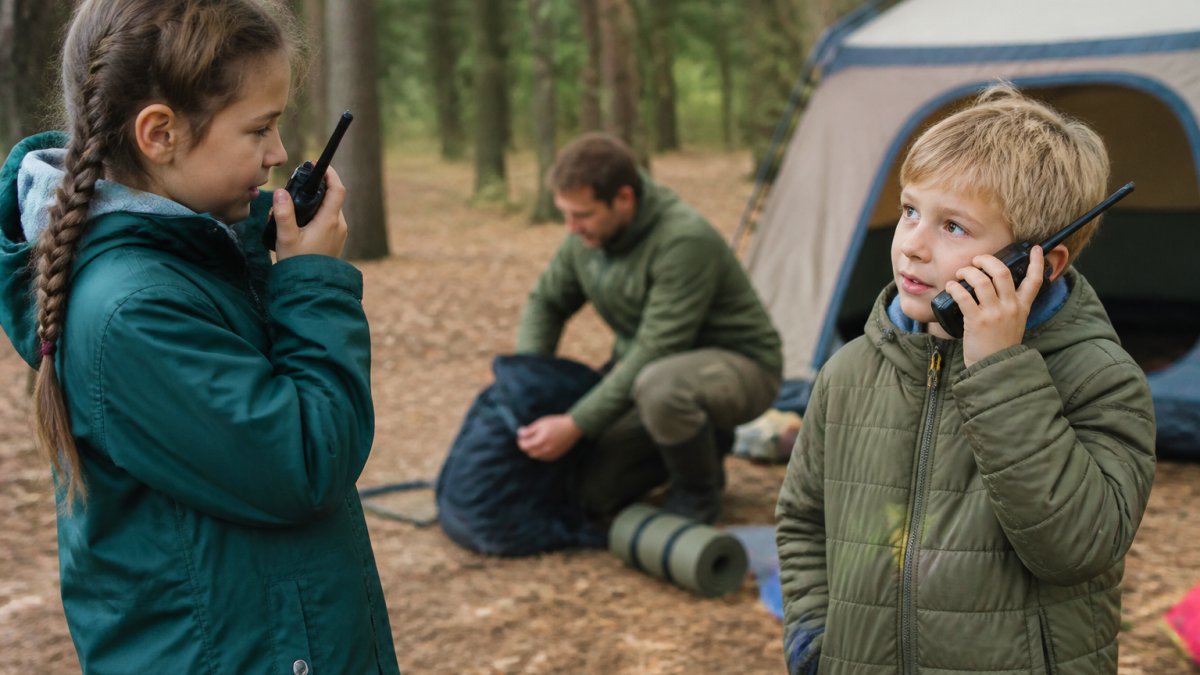
Run through this checklist before every trip:
- Charge every handset the night before
- Pack spare batteries or a power bank
- Test each radio on the same channel
- Agree on a check-in time and a call signal
- Clip lanyards on so handsets stay off the ground
- Set volume to a level kids can hear over wind
Age Suitability, Safety and Channel Interference
Age suitability starts around three years for a simple push-to-talk handset, with older kids handling more features. The controls should be big enough for small hands and simple enough to work without an adult.
Safety and privacy deserve a mention. Walkie-talkies broadcast on shared channels, so anyone nearby can hear the conversation. Teach kids to keep personal details off the air, and pick a channel away from the busiest ones to reduce interference and chatter from other users.
Shared channels mean strangers can hear your child. Agree on a family channel, keep names and addresses off the radio, and explain why the conversation is not private.
What Rechargeable Walkie Talkies for Kids Cost to Own
Total cost of ownership matters more than the sticker price. The gap is easy to underestimate because the ongoing cost is spread across months and rarely tracked.
The Battery Maths, Plainly
A typical kids' walkie-talkie takes three or four AA cells per handset. A family that uses the radios most weekends will burn through a pack of cells every few weeks, more in cold weather, when cheap alkaline cells fade fast. Over a year of regular weekend use, the disposable-battery bill for a pair of handsets can easily approach or exceed the price difference between a budget battery-powered set and a rechargeable one.
What to Check Before You Buy
Weigh the sums before you buy, and look past the sticker:
- Upfront price: the cost of the set itself, including any charging dock or cable.
- Battery pack type: a user-replaceable pack keeps the set working for years; a sealed cell turns the whole handset into landfill when it fades.
- Charge time and playtime: a few hours to full charge is typical, and a full day of play per charge is a reasonable expectation for most kids' sets. Check the standby figure too, since a radio left switched on between bursts of play drains slowly.
- Degradation: all lithium packs lose capacity over time. Expect a noticeable drop after a couple of years of heavy use, which is exactly why a replaceable pack matters.
- Replacement parts: spare battery packs, lanyards and charging cables should be available from the retailer. Check shipping and delivery details before you commit, especially if you are buying a spare pack later.
- Warranty and support: a set with a clear warranty and accessible support is worth more than a cheaper one with none. Under Australian Consumer Law, goods must be of acceptable quality and fit for purpose, and remedies apply if a product fails prematurely, keep your receipt.
- Lifespan: a repairable set with a replaceable pack lasts longer and costs less per year of use than a cheap set that dies in a season.
The Verdict for Most Families
For occasional use, a camping box that comes out twice a year, a battery-powered set is fine and the running cost is trivial. Buy for the years, not the weeks.
Conclusion
Getting kids off screens takes a toy that competes with the tablet on fun, and a walkie-talkie does that by making the outdoors the game. The Talkio™ Kids Walkie Talkies are built for exactly this: a kid-tough design that handles drops and dirt, a range of up to 3 km in open areas, and simple push-to-talk controls that even young children can work on their own. Ready to get the kids outside? Shop the Talkio™ Kids Walkie Talkies and let the adventure begin.

Frequently Asked Questions
How long do walkie-talkie batteries last on a kids' set?
It depends on the power source and how much the kids talk. Sets that take AA or AAA batteries drop off gradually and need fresh cells mid-trip if you forget spares. Standby time is always longer than talk time, so a set left switched on but mostly silent will last far longer than one used constantly during a game of hide and seek.
Are rechargeable walkie-talkies better than ones that use disposable batteries?
For regular backyard and neighbourhood use, rechargeable sets usually win on total cost of ownership because you stop buying AA batteries every few weeks. Disposable-battery models still suit camping trips where there is no power point, or families who want a set that is ready instantly with fresh cells. Some parents buy rechargeable sets for home and keep a battery-powered pair as backup. The Talkio Kids Walkie Talkies run on AA batteries (included) and suit families who want a set that works straight out of the box.
What range do kids' walkie-talkies need for outdoor play?
For backyard play and supervised neighbourhood exploration, a quoted range of 1 to 3 km is plenty, because real-world range is always shorter than the box claim. Walls, trees, hills and crowded suburbs all cut distance. Long-range walkie-talkies for kids that advertise 3 km in open areas will usually manage a few hundred metres between houses. If you plan to split up across a campsite or park, check the open-field figure and test the set on site before letting kids roam.
Are walkie-talkies safe and easy for young children to use?
A basic push-to-talk set is one of the simplest screen-free tools a child can operate. There is no internet connection, no in-app purchases and no account to set up, which removes most of the privacy concerns parents raise about connected toys. Look for a recommended age on the pack (the Talkio set is rated 3+ years), a chunky push-to-talk button, adjustable volume and a lanyard so the unit does not get dropped. Teach kids to keep the aerial away from their face and to use a shared channel only with people they know.
